
Crowdly

Add to Chrome
ECNG1012 : Engineering Science and Technology (Semester I- 2024/2025)
Looking for ECNG1012 : Engineering Science and Technology (Semester I- 2024/2025) test answers and solutions? Browse our comprehensive collection of verified answers for ECNG1012 : Engineering Science and Technology (Semester I- 2024/2025) at myelearning.sta.uwi.edu.
Get instant access to accurate answers and detailed explanations for your course questions. Our community-driven platform helps students succeed!
Which of the following is NOT true for fixed biasing method:
0%
0%
0%
0%
View this question
Cut-off frequency is defined as the frequency at which the characteristic response of the BJT is -3dB with respect to the midband or maximum response.
0%
0%
View this question
How many terminals does a BJT posses ?
0%
0%
0%
0%
View this question
Fill in the blank:The BJT can be viewed as two ____ with a common terminal.
✅
❌
❌
❌
View this question
The purpose of R3 in the above H-Bias configuration is:(1) To form a potential divider with R1.(2) To set the base potential of the transistor.(3) To block the input current.(4) To form a potential divider with Re. 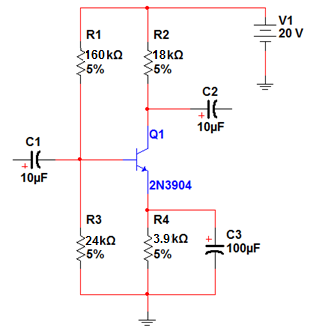
0%
0%
0%
0%
View this question
Which of the following is not a region of operation for a BJT ?
0%
0%
0%
0%
View this question
We can determine the measured voltage gain of a fixed-bias circuit in the laboratory using the following relationship:
0%
0%
0%
0%
View this question
The Q-Points in a transistor are:
0%
0%
0%
0%
View this question
During design, DC Analysis can be used to set or determine the maximum swing of a BJT amplifier. It can also be used to bias the amplifier for symmetrical swing. This procedure is performed by open circuiting all capacitors. The resulting network can then be used to determine maximum swing and if the swing is symmetrical.
0%
0%
View this question
In Multisim, the frequency response of an amplifier circuit can be seen using which of the instruments found on the Instrument toolbar?
❌
❌
✅
❌
View this question